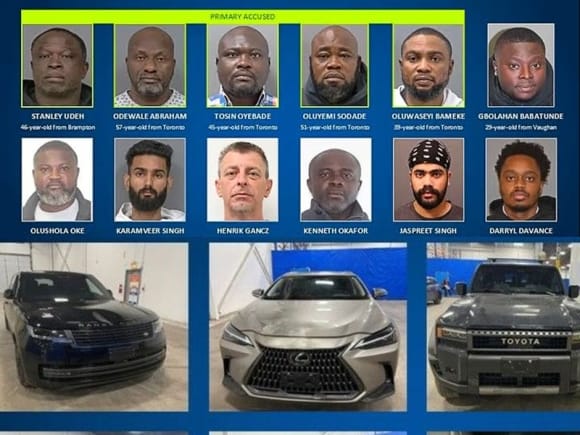
The 8 Nigerians recently arrested in Canada over their alleged involvement in an international car theft syndicate accused of stealing high-value vehicles and shipping them to West Africa, may face stiff immigration action, including removal from Canada.
According to the police, individuals charged by Peel Regional Police may be referred to the Canada Border Services Agency for
possible immigration action, including removal from Canada.
The suspects were arrested by Peel Regional Police in Ontario following months of investigations into the criminal network, which allegedly specialised in stealing luxury vehicles, altering their identification details and exporting them through Canadian ports.
The police said the investigation, conducted in partnership with the Canada Border Services Agency (CBSA), began in March 2026 and resulted in the arrest of 12 people, including the eight Nigerians.
The arrested Nigerians were identified as Stanley Udeh, Olusola Oke, Odewale Abraham, Tosin Oyebade, Oluyemi Sodade, Oluwaseyi Bameke, Gbolahan Babatunde and Kenneth Okafor.
According to the police, the suspects collectively face 231 charges, while arrest warrants have also been issued for other individuals allegedly connected to the syndicate.
96 stolen vehicles recovered
During the investigation, police recovered 96 high-value vehicles concealed in shipping containers and allegedly prepared for export through Canadian ports.
The recovered vehicles are estimated to be worth approximately $4.5 million.
Investigators said the criminal network operated through coordinated activities involving the theft of vehicles, transportation to loading locations, alteration of identification numbers and movement of the stolen cars into shipping containers.
Police alleged that the syndicate was led by five individuals who coordinated the theft, transportation and export of the vehicles, while other members played supporting roles.
In a statement, Peel Regional Police said investigators were able to link the network to several loading sites, container movements and the transportation of stolen vehicles whose identification numbers had been illegally altered.
The practice, known as re-VINing, involves changing a vehicle’s Vehicle Identification Number (VIN) to conceal its original identity and make it difficult for law enforcement agencies to trace.
Suspects face possible deportation
The police disclosed that nine of the 12 suspects arrested had been charged and released pending future court appearances.
Three others were initially held for bail hearings but were subsequently released.
The authorities also warned that some of those charged could face immigration enforcement proceedings after the conclusion of their criminal cases.
According to the police, individuals charged by Peel Regional Police may be referred to the Canada Border Services Agency for
possible immigration action, including removal from Canada.
Reacting to the arrests, Peel Regional Police Deputy Chief, Nick Milinovich, described organised vehicle theft as an increasing threat to public safety and security.
He said the operation demonstrated how vehicle theft had become part of wider transnational criminal activities.
“Organised auto theft is a predatory business model run by transnational syndicates that terrorise families and fund broader criminal enterprises,” Milinovich said.
The trafficking of stolen vehicles from North America and Europe to African countries has remained a concern for law enforcement agencies, with criminal networks allegedly exploiting international shipping routes to move stolen cars across borders.